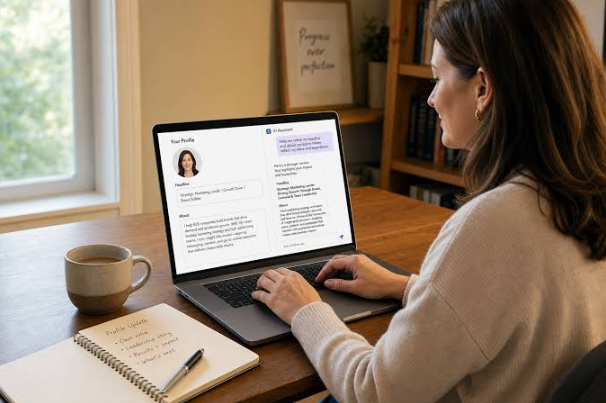
Your professional profile is often the first thing employers notice about you. Whether they find you through a job platform, social network, or application, your profile should quickly answer one important question: what can you bring to the table?
A strong profile isn’t simply a list of jobs you’ve held. It should tell the story of your experience, skills, achievements, and professional growth. The good news is that you don’t need complicated language or a long biography to make it effective. You just need to present the right information in a clear and honest way.
Start With a Clear Professional Introduction
Think of your introduction as a short professional snapshot. Someone reading it should understand your area of expertise, level of experience, and the kind of work you’re interested in.
For example, instead of writing, “I have worked in marketing for several years,” you could say, “I’m a digital marketing professional with five years of experience in SEO, content strategy, and social media campaigns.”
The second version gives the reader much more useful information immediately.
Keep your introduction natural. Avoid filling it with buzzwords such as “dynamic,” “passionate,” or “results-driven” unless you actually explain what those qualities mean through your experience.
Focus on Experience, Not Just Job Titles
Job titles can tell employers where you worked, but they don’t always explain what you actually did.
When describing previous positions, focus on responsibilities and outcomes. Think about the projects you handled, problems you solved, customers you helped, or improvements you made.
Instead of saying:
“Managed social media accounts.”
Try something more specific:
“Managed social media campaigns across three platforms and increased monthly engagement through targeted content.”
Specific details make your experience feel real. Whenever possible, include numbers, percentages, project sizes, or other measurable results.
Highlight Skills That Support Your Experience
Your skills section should complement your work history rather than repeat it.
Consider the abilities you use regularly in your professional life. These might include technical skills, communication, project management, research, writing, customer service, data analysis, or industry-specific knowledge.
It’s also worth separating skills you’re highly experienced in from those you’ve only recently started learning. A realistic profile is more convincing than one that claims expertise in everything.
Ask yourself, “What skills would I want an employer to notice within the first few seconds?” Those deserve a prominent place in your profile.
Show How Your Career Has Developed
Experience isn’t only about the number of years you’ve worked. Career development matters too.
Maybe you started as an assistant and eventually became a team leader. Perhaps you moved from customer support into sales or developed technical skills while working in another field. These changes show adaptability and a willingness to learn.
Don’t be afraid to explain your progression. Employers often want people who can grow with a role, so your career journey can be just as valuable as your current position.
Use Examples Instead of Empty Claims
One of the easiest ways to improve a profile is to replace general statements with evidence.
Anyone can say they’re organized. A better approach is to explain how you managed multiple projects while meeting deadlines.
Anyone can say they have leadership skills. Instead, mention a team you supervised, a project you coordinated, or a problem you helped your colleagues solve.
Examples give your claims credibility. They also make your profile more interesting to read.
Keep Your Career Goals Relevant
Your profile should reflect where you’ve been, but it can also give employers an idea of where you’re going.
If you’re currently searching for opportunities, make sure your profile matches the type of position you want. Someone using หางาน resources, for example, should make sure their professional information clearly communicates their experience and preferred career direction.
Similarly, when you’re ready to สมัครงาน, your profile should make it easy for recruiters to understand why you’re suitable for the position.
Your goals don’t need to sound overly ambitious. A simple statement about the type of work you want and the value you hope to provide can be enough.
Make Your Profile Easy to Read
Even an impressive career history can lose its impact if the profile is difficult to scan.
Use short paragraphs, clear headings, and concise descriptions. Avoid huge blocks of text. Recruiters may review dozens of profiles in a short period, so important information should be easy to find.
Review your wording carefully, too. Small spelling or grammar mistakes can make an otherwise strong profile look rushed.
Update Your Profile as You Grow
Your profile shouldn’t be something you create once and forget.
Whenever you complete an important project, learn a new skill, receive a promotion, or take on additional responsibilities, consider updating it.
Regular updates also help you notice your own progress. Sometimes we don’t realize how much we’ve learned until we look back at our experience.
Let Your Experience Tell Your Story
A strong professional profile doesn’t try to make you sound perfect. It gives an honest picture of what you’ve learned, what you’ve accomplished, and what you can offer next.
Focus on real experience, useful skills, measurable achievements, and clear career goals. Keep the language simple and make every section contribute something meaningful.
Most importantly, make sure the profile sounds like you. Your experience is unique, and the best profile is one that presents that experience confidently without exaggerating it.