Reviewed by a licensed speech-language pathologist
Quick answer: A speech delay and reduced eye contact can happen together, but neither one alone points to a single cause. A late talker who still connects warmly is a different picture than a child with both a speech delay and consistently limited eye contact. Only an evaluation can tell them apart.
Many parents start watching their child’s eyes as closely as their words. If a toddler is slow to talk and also seems to avoid looking at faces, it is natural to wonder whether the two are linked and what that link might mean. The pairing of speech delay and eye contact comes up often in parenting searches, and the pairing matters, but not in the simple way it is sometimes described online. Each sign carries information, and reading them together takes more than adding them up.
What does eye contact actually tell us?
Eye contact is one small window into a child’s social engagement. When a young child looks toward a caregiver’s face, shares a glance to point something out, or checks back after a surprise, those moments show that the child is tuned into other people. That shared attention is closely tied to how language develops, because children learn words by connecting sounds to what someone is looking at or pointing to.
Still, eye contact varies from child to child and moment to moment. Some children look away when they are thinking hard, tired, or taking in a lot at once. A single afternoon of little eye contact says almost nothing. What clinicians look for is a steady pattern across settings and days, not a snapshot.
What does a speech delay tell us on its own?
A speech or language delay means a child is developing communication later than the typical range for their age. The American Speech-Language-Hearing Association describes late language emergence in children who are otherwise developing well but are slow to produce words. Many of these late talkers understand language, follow directions, and use gestures to make themselves understood. Their delay sits in spoken output rather than in the desire to connect.
The National Institute on Deafness and Other Communication Disorders lists age-based expectations for words and sentences that families can use as reference points. A delay measured against those ranges is a reason to pay attention, but by itself it does not name a cause. Hearing differences, oral-motor issues, a language-rich or language-quiet home, and broader developmental differences can all sit behind a slow start with words.
Why do the two get discussed together?
Speech delay and eye contact are often mentioned in the same breath because both can be early features of autism, where differences in social communication show up across several areas at once. When a child has a speech delay along with consistently limited eye contact, reduced shared attention, and few gestures, that cluster is worth a careful look.
The key word is cluster. Autism is not identified by any single behavior. It is a pattern across social communication and behavior over time. A speech delay with strong eye contact, warm back-and-forth play, and clear gestures paints a very different picture than a delay paired with a steady lack of social connection. This is why the same delay can mean different things depending on what surrounds it.
How can parents tell a plain late talker from something broader?
There is no home checklist that settles this, but a few questions help frame what you are seeing. Does the child seek you out to share things, or mostly stay in their own world? Do they respond to their name most of the time? Do they use pointing, waving, or reaching to communicate before words arrive? Do they enjoy simple back-and-forth games? A child who connects in these ways, even without many words, is often described as a late talker rather than a child with a broader social difference.
The Centers for Disease Control and Prevention provides milestone lists that make these patterns easier to track over time. Watching the trend across weeks tells you far more than any single day, and it gives an evaluator useful information.
What should parents do while sorting this out?
The most useful step is to request an evaluation rather than wait. You do not need a referral, and early intervention programs accept parent requests directly. A speech-language pathologist, and when needed a developmental specialist, can assess both language and social communication and explain what the signs mean together.
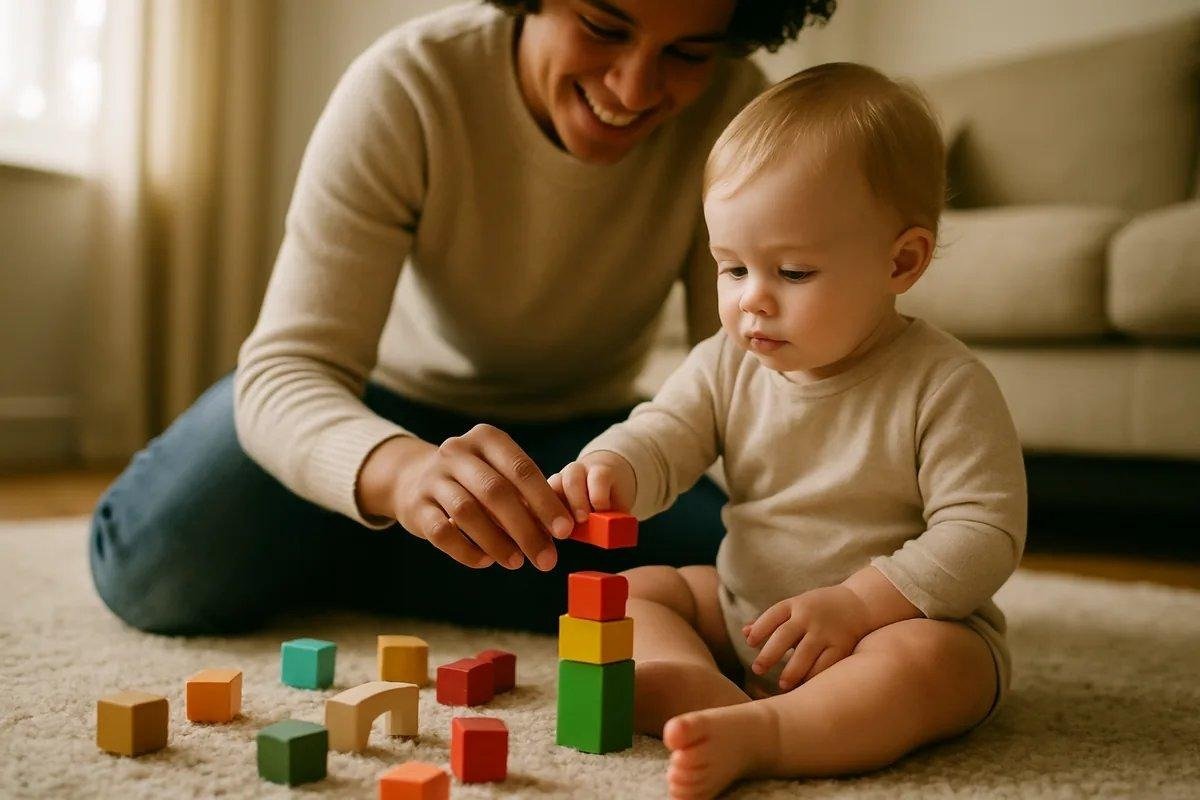
Between the request and the first session there is often a wait, and everyday interaction is where a lot of growth happens anyway. Get down to the child’s eye level during play, name what you are both looking at, pause to give a turn, and respond warmly to any sound or gesture the child offers. These moves invite both more talking and more looking, because they tie words to shared attention. Some families add short daily practice through play, and voice-first tools such as this speech-practice app offer low-pressure turn-taking that can complement the work a clinician does. Home practice is a supplement to therapy, not a replacement for it, and it should stay light and playful rather than becoming a test.
Key takeaways
- Speech delay and eye contact each carry information, but neither one alone identifies a cause.
- Eye contact varies by mood and focus, so clinicians watch consistent patterns, not single moments.
- Many late talkers make warm eye contact and use gestures, which points toward a delay in words rather than a broader social difference.
- When a speech delay appears alongside steadily limited eye contact and reduced shared attention, that cluster deserves an evaluation.
- Parents can request an evaluation early, and everyday play that invites turn-taking supports both language and connection.
Frequently asked questions
Does a speech delay with poor eye contact always mean autism?
No. The two can appear together in autism, but they can also appear on their own for other reasons. A full developmental evaluation is the only way to know what is behind them.
Is reduced eye contact normal in toddlers?
Eye contact varies with temperament, mood, and focus. Many young children look away when concentrating or overwhelmed, so clinicians watch for a consistent pattern rather than one moment.
Can a child have a speech delay but strong eye contact?
Yes, and this is common with late talkers. A child who makes warm eye contact, shares attention, and uses gestures often has a delay in spoken words rather than a broader social difference.
When should I ask for an evaluation?
If you have concerns about talking, eye contact, or both, you can request an evaluation without waiting for a referral. Acting early carries little downside and helps sort out what is happening.
Does more talking practice improve eye contact?
Back-and-forth play and shared attention naturally invite more looking and connecting. Practice that involves turn-taking supports both language and social engagement, though it does not replace an evaluation when concerns remain.
Sources
- American Speech-Language-Hearing Association: Late Language Emergence (asha.org)
- Centers for Disease Control and Prevention: Developmental Milestones (cdc.gov)
- National Institute on Deafness and Other Communication Disorders: Speech and Language (nidcd.nih.gov)
- American Speech-Language-Hearing Association: Speech and Language Developmental Milestones (asha.org)
- American Academy of Pediatrics (HealthyChildren.org): Toddler Development (healthychildren.org)